
If you intend to donate plasma in the United States, familiarizing yourself with the donation criteria is the essential initial step. Whether your goal is to support life-saving efforts or supplement your income, being aware of the qualification guidelines can streamline your process and guarantee a seamless donation.
Why Plasma Donation Matters
Plasma is the liquid portion of your blood that contains antibodies and essential proteins. It is used to create life-saving therapies for people with immune disorders, bleeding conditions, and burn injuries. Companies like CSL Plasma, BioLife Plasma Services, and Octapharma Plasma operate hundreds of donation centers across the United States.
Because plasma is used for medical treatments, the FDA has strict eligibility standards for donors.
Basic Plasma Donation Requirements in the United States
Here are the general requirements you must meet before donating plasma:
| Requirement Category | Details | Why It Matters |
|---|---|---|
| Age Requirement | Must be at least 18 years old | Ensures legal eligibility to donate |
| Some states may require donors to be 19 years old | State-level regulations may vary | |
| Valid government-issued photo ID required | Used to verify age and identity | |
| Weight Requirement | Must weigh at least 110 pounds (50 kg) | Ensures safe plasma collection volume |
| Weight determines how much plasma can be collected | Protects donor safety during donation | |
| Valid Identification | Government-issued photo ID (Driver’s license or state ID) | Confirms identity |
| Social Security number or Social Security card | Required for registration and payment | |
| Proof of local address (utility bill, lease, or mail) | Confirms current residency |
Health & Medical Plasma Donation Requirements
Your health plays a major role in eligibility.
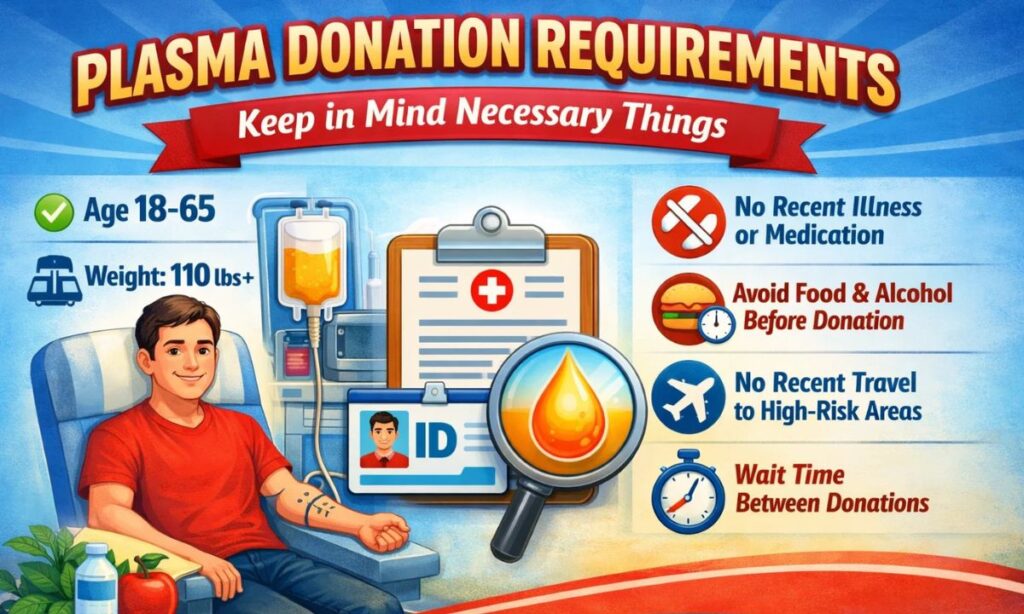
4. General Good Health
You must:
- Feel healthy on the day of donation
- Have normal blood pressure
- Have acceptable pulse and temperature readings
5. Hemoglobin & Protein Levels
Before every donation, your:
- Hemoglobin (iron levels)
- Total protein levels
will be tested to ensure safe donation.
6. No Active Infections
You cannot donate if you:
- Have a fever
- Have active infections
- Have certain chronic diseases
Medical Conditions That May Disqualify You
Some conditions may temporarily or permanently prevent donation:
- HIV/AIDS
- Hepatitis B or C
- Certain heart conditions
- Recent major surgery
- Recent tattoos or piercings (deferral period varies by state)
Each plasma center may have slightly different screening policies based on federal guidelines.
Travel & Lifestyle Plasma Donation Requirements
You may be deferred if you:
- Recently traveled to certain countries with high-risk diseases
- Used intravenous drugs
- Had recent blood transfusions
- Are currently pregnant (varies by center policy)
Always answer screening questions honestly. Your safety and patient safety depend on accurate information.
How Often Can You Donate Plasma in the U.S.?
Under FDA guidelines, you can donate:
- Twice within a 7-day period
- With at least one full day between donations
For example:
- Donate Monday → Next donation Wednesday or later.
First-Time Donor Requirements
If you’re donating for the first time, expect:
- Registration process
- Medical history questionnaire
- Physical exam
- Blood test screening
- Educational video
Your first visit may take 2–3 hours. After that, regular visits usually take 60–90 minutes.
What to Bring to Your First Appointment
Before heading to a plasma center, bring:
✔ Valid Photo ID
✔ Social Security Number
✔ Proof of Address
✔ Water & light snack
✔ Wear comfortable clothes
Tips to Qualify for Plasma Donation
To make sure you meet plasma donation requirements:
- Drink plenty of water 24 hours before donating
- Eat a protein-rich meal (chicken, eggs, beans, yogurt)
- Avoid alcohol before donation
- Get good sleep
- Avoid fatty foods
These steps help maintain healthy protein and iron levels.
Temporary Deferrals vs Permanent Disqualifications
It’s important to understand the difference:
| Type | Meaning |
|---|---|
| Temporary Deferral | You can donate later (low iron, recent tattoo, illness) |
| Permanent Deferral | You cannot donate due to serious medical risk |
If deferred, the center staff will explain when you can return.
Plasma Donation Requirements for Compensation
If you’re donating plasma for money in the U.S.:
- You must meet all medical eligibility requirements.
- Payments are typically loaded onto prepaid debit cards.
- Compensation varies by state and promotion.
Most U.S. donors can earn between $400–$800 per month, depending on frequency and center promotions.
FAQ
Can I donate plasma if I have tattoos?
Yes, but there may be a waiting period depending on when and where you got the tattoo.
Can I donate if I take medication?
It depends on the medication. Some prescriptions are allowed, others are not. Always disclose medications during screening.
Final Thoughts
Understanding plasma donation requirements helps you prepare and avoid surprises at the center. In general, you must:
- Be 18+
- Weigh at least 110 lbs
- Be in good health
- Pass medical screening
- Provide valid identification
If you meet these requirements, donating plasma can be a safe way to help patients in need while earning extra income.
Before visiting a center, always check their official website or call ahead to confirm specific requirements in your state.